
zerofox logo
Platform_header_background_2
VALIDATE

Validate Real and Relevant Threats

Decision-grade intelligence for stopping threats.

ZeroFox helps your security team determine what is real, relevant, and actionable so you can move with certainty, not speculation.
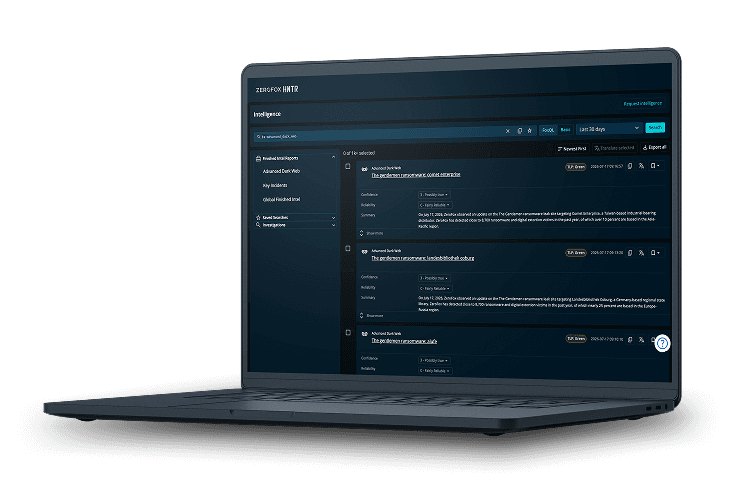
Validate Real and Relevant Threats

Signals Are Easy. Meaning Is Hard.

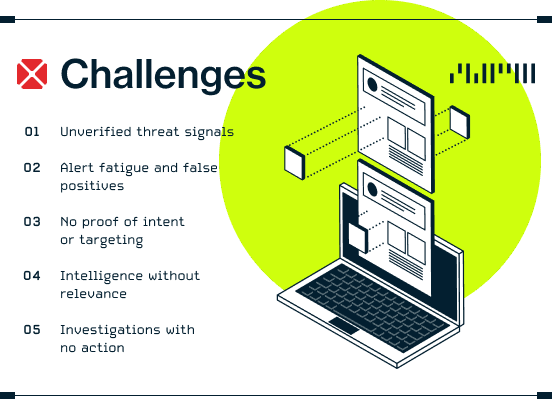
The internet generates endless signals: alerts, indicators, chatter, and possible threats. Most lack context. Many lack intent. Few are actually targeting your organization.

Without validation, security teams spend their time chasing noise while real adversaries prepare, coordinate, and adapt out of sight. Activity without meaning leads to investigations without outcomes.

ZeroFox validates threats so teams act on truth, not speculation.
Brand Impersonation and Fraud on the Rise

%

of SOC analysts report alert fatigue 1

%

of organizations admit they lack confidence in their ability to prioritize real threats 2

%

of phishing attacks spoof real brands 3

Validate What’s Real

ZeroFox transforms raw discoveries into verified, decision-ready intelligence by confirming intent, ownership, relevance, and imminence—creating confidence backed by evidence and human expertise.

Confirms whether activity signals preparation, targeting, or execution so you can understand the behavior of threat actors.

The ZeroFox Advantage

B

data points correlated daily

M

domains/URLs scanned daily

M+

digital asset protected annually

How ZeroFox Validates Threats

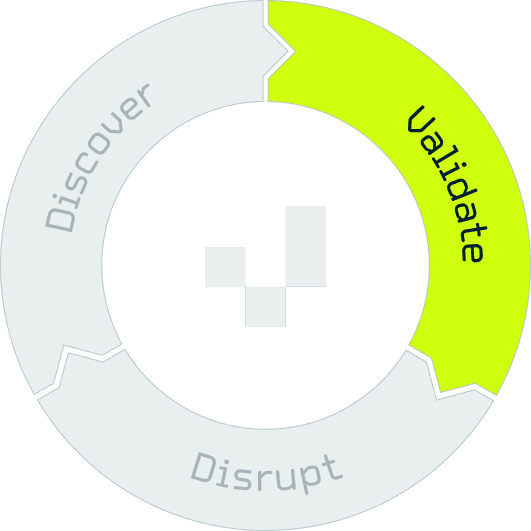
ZeroFox follows a multi-stage intelligence process that combines automated collection, analysis and correlation, and expert judgment to determine whether a threat is real, relevant, and actionable.
ZeroFox collects intelligence directly from the environments where adversaries operate—across digital platforms and human-driven channels—capturing early signals of intent, coordination, and preparation. Direct findings span surface, deep, and dark web sources and continuously track how threat activity and TTPs develop rather than relying on point-in-time observations.

Why ZeroFox Leads in Threat Validation

ZeroFox uncovers threats across the digital landscape with unmatched depth, speed, and accuracy.

Brand_Domain

Intent, not just indicators

ZeroFox validates threats based on adversary behavior, not isolated indicators.deep and dark web.

Vulnerability Investigation

Evidence-based decisions

Every validated threat includes evidence that explains why it matters and why it requires action.

Verified Profile

Human-in-the-loop insights

Human analysts confirm and verify contexts, behaviors, and intent where automation alone just scrapes pages.

Strategy

Organization orientation

Validation begins with your organization and filters out unrelated activity by design.

EP

Embedded analysts deliver HUMINT

DarkOps intelligence teams monitor closed and underground channels to discover threats as they emerge.

Report

SANS 2025 AI Survey: Measuring AI’s Impact on Security Three Years Later

Frequently asked questions

Threat validation determines whether observed activity represents a real threat that is relevant to your organization and ready for action. It confirms intent, ownership, and credibility using evidence, not assumptions. Validation separates meaningful risk from background noise so teams can focus on threats that require intervention.
Most platforms emphasize collecting and surfacing indicators, leaving analysts to determine relevance on their own. ZeroFox is designed to verify which activity is real, targeted, and operationally significant before it reaches analysts. This shifts effort away from investigation and toward action, enabling teams to focus on stopping threats rather than continuously analyzing raw intelligence.
ZeroFox validates intent by analyzing how activity evolves over time, including changes in behavior, coordination, language, and infrastructure setup. When signals progress from discussion to preparation and staging, intent becomes clear. This approach distinguishes meaningful threat development from opportunistic or speculative activity that does not warrant response.
Some threats rely on nuance, deception, and context that automated systems cannot reliably interpret. Human analysts review high-risk and ambiguous activity to confirm intent, eliminate false positives, and recognize emerging tradecraft. This ensures accuracy and prevents unnecessary escalation while maintaining confidence in validated findings.
Validation applies strict criteria before activity is surfaced, requiring proof of intent, relevance, and credibility. Malicious but unrelated activity is filtered out early. As a result, analysts receive fewer alerts, spend less time investigating noise, and focus their efforts on threats that have already been proven real and actionable.
  • [1] 1 SOC Survey: Security Operations Center (SOC) Survey, 2023, Sans Institute
  • [2] State of Cybersecurity Resilience 2023, Accenture
  • [3] 2024 Data Breach Investigations Report (DBIR), Verizon